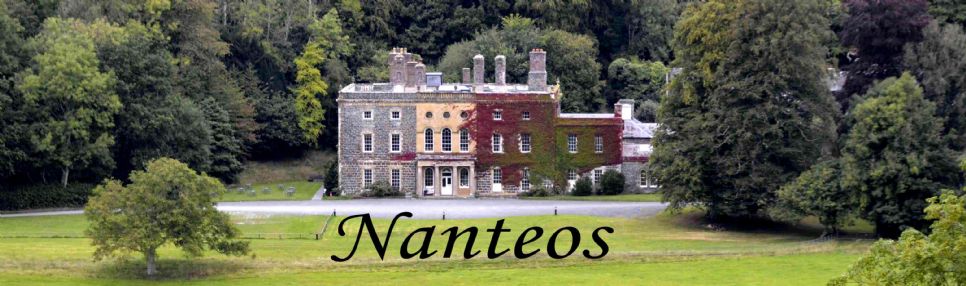
The Boy who would be Galahad
Billy Powell and the Nanteos Cup
Ian Pegler 2.12.25
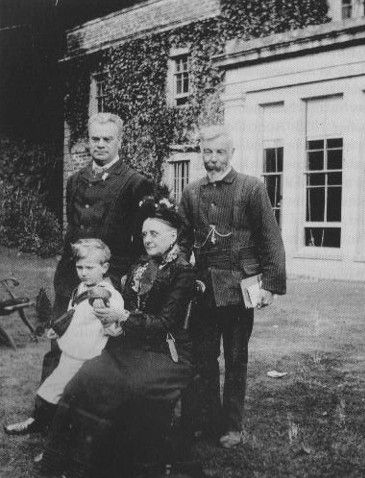
The photograph at the top of this article was taken at Nanteos in 1904. It shows four people; the gentleman at the back left is Dr. John McClure, the president of the British Chautauquans in 1904 and for many years headmaster of Mill Hill school. The bearded gentleman with the double Albert chain to his right is the knowledgeable local antiquarian George Eyre Evans. Seated in the chair is the elderly Anna Maria Powell, lady of the manor of Nanteos and on her lap is her grandson.
A local newspaper described an occasion in 1905 when this photograph was shown as one of a number of slides at a presentation at Byron Hill church in Harrow:
“Mr. [Robert] Smith showed on the screen some 40 views of the district, including the Abbey [Strata Florida], Nanteos, the Cup by itself, and also in the hand of the grandson of Mr. and Mrs. Powell. Included in the portraits were those of Mr. W. D. Howells, D. Litt. the noted American author, who was present at Nanteos on the occasion of the lecture; "J.B." of the "Christian World," Dr. J. D. Maclure [sic], the President; Rev. C. H. KelIy, Thomas Williams; and the local guide of the "British Chautauqua." ” [Emphasis added]
The grandson holding the Cup is the young William Edward George Pryse Wynne Powell, the only child of Margaret Powell, known as Billy. He appears to have one arm in a sling so evidently it was hurt or broken. He holds the Cup with one hand (matching the description in the article) atop some sort of base which is not part of the Cup and which seems to have vanished into the mists of time.
This is a most sad and poignant photograph with the benefit of retrospect – it was Billy who would go on to join the Welsh Guards and fight for King and Country in the Great War only to perish days before the Armistice in November 1918. If he had lived he would have gone on to become lord of the manor of Nanteos and the Powell family line might have survived.
In one or two of the items which Fred Stedman-Jones had written on the subject of Sir Galahad he commented:
“Mrs [Margaret] Powell in her old age, deaf and alone with her memories, remembered her son as a young Galahad and the Healing Cup entrusted to the Powell family was surely the Holy Grail; it had been sought by the Church at Glastonbury as such but it was still her duty to be its Guardian.”
Fred had this idea that Margaret Powell saw her son Billy as a personification of Sir Galahad – an embodiment of chivalry, nobility and purity of heart. He quoted a letter from H. E. Luxmoore to G. F. Watts, written in January 1900:
“… I have this very morning a letter from a heartbroken mother whose boy (only child) was shot last week in Ladysmith. She says “His favourite picture was the one you gave him” (a print of Sir Galahad). He also was an innocent knight' (the boy was not 21) ...”
H. E. Luxmoore was a master at Eton – Billy’s school – and it was Luxmoore who persuaded Watts to donate one of his paintings of Sir Galahad to Eton where it hangs in the chapel opposite the entrance door. Every Etonian boy – including Billy – would have passed by it each time they went to and from morning and evening prayers.
Coinciding roughly with Robert Smith’s presentation at Harrow came the publication of Ethelwyn Mary Amery’s Sought and Found – a story of the Holy Graal. The final chapter of this work related a simplified account of a visit by unnamed guests (who in fact were the British Chautauquans) to Nanteos. This chapter is a postscript to the main section of the book which deals with the Arthurian Grail Quest in which Sir Galahad succeeds but sacrifices his life. The Grail is then brought West, not by monks from Glastonbury in 1539 but by a single priest some time after Galahad’s death. As the story moves on it jumps rather jarringly into the early 20th Century to when the visitors arrived at Nanteos. There is no mention of a grandson. Although it was George Eyre Evans who talked to the visitors we are told by Amery that it was the lady of the manor who made a speech. In the final paragraph we are told that the Nanteos Cup is “none other than the one from which our Lord drank at the Last Supper” and the work closes with the words “The pure in heart shall see God”. This is reminiscent of both biblical scripture (cf. Matthew 5:8) and the description of Sir Galahad in various works including the poem Sir Galahad by Tennyson:
My good blade carves the casques of men,
My tough lance thrusteth sure,
My strength is as the strength of ten
Because my heart is pure.
We might imagine that young Billy would have read Amery’s book or perhaps his grandma read it to him. He would have certainly read some of Tennyson’s poems whilst at Eton and these might have included Sir Galahad and The Charge of the Light Brigade. It was Tennyson’s Holy Grail poem (part of The Idylls of the King) which inspired local journalist William Robert Hall to compare the Nanteos Cup to the Holy Grail in 1880.
Britain suffered over 886,000 combat-related deaths during the Great War and over half a million of those still have no identifiable grave. The author John Nichol in his excellent work The Unknown Warrior describes vividly the state of mind of a nation bereaved and in shock:
“The dead were inescapable. Their shadows stood on every street corner, sat at every bar, travelled on every bus.”
The Powells of Nanteos, like so many other families, had suffered a loss. Billy had a marked grave but in a foreign field. After the war there was a great clamour for the repatriation of dead servicemen but this had been disallowed; their numbers were too great and so many of them were unidentifiable, their whereabouts uncertain. Even today, work is still being done to discover and identify remains of soldiers from the Great War and to give them a decent burial. Billy was not one of the “missing” but he was still missing from his home. What is the effect of the loss of an only child on his parents?
It was in the wake of Margaret Powell’s bereavement for her son Billy that a new story of the Nanteos Cup began to emerge. This was born of her reminiscences of happier times when Billy was alive. According to this revised narrative the Cup had come to Strata Florida abbey from Glastonbury after the dissolution of the monasteries – this was not the story as previously told by Ethelwyn Amery. In Amery’s account, Glastonbury had been merely mentioned and the Holy Grail had subsequently moved on from there; it was rediscovered by the questing knights Lancelot, Bors and Galahad in a chapel at an unspecified, fictional British location. In Margaret Powell’s new version the knights had been sidelined, merely incidental to the real history of the Nanteos Cup. This new account emerged in printed form just six years after the death of Billy Powell.
Margaret’s new account was based on her memory of an occasion (approximately in 1910) when she had visited the headmaster of a military prep-school near Aldershot. Young Billy Powell was there, apparently attending the school. It was at this time that Margaret said she remembered that the headmaster (a man named John Bacon) had shown her a history-book containing an account of how the Nanteos Cup had been taken from Glastonbury “over the impassable mountains” to their “brethren” at Strata Florida at the time of the dissolution of the monasteries.
We know that Margaret’s visit to Aldershot did take place and the headmaster did remember young Billy Powell and he also remembered showing Margaret a history-book but all attempts to rediscover it ended in failure. Was this history-book ever real? Today it is unidentifiable and one must ask why. It could have been a forgery, alternatively a deliberate lie on Margaret Powell’s part. More likely, however, perhaps Margaret saw a history book belonging to Bacon but misremembered its contents with the passage of time. She had convinced herself of its genuineness to the point of trying to identify the book by making enquiries of experts.
There never was anything of substance that connected the Cup to Glastonbury but Margaret Powell clung to her beliefs as she did the Cup itself because it represented a sentimental – perhaps even mystical – link to her son Billy, the tragic young Galahad who never came home.
References and further reading:
Welsh Gazette and West Wales Advertiser, 6th April 1905, p.8, col 1 under "Aberystwyth … Interesting Lecture"
Link: https://newspapers.library.wales/view/3866101/3866109/72/
Letters of H. E. Luxmoore, Cambridge University Press, 1929, page 79, letter to G. F. Watts, Jan 15, 1900.
The Quest for the Grail: Arthurian Legend in British Art 1840-1920, Christine Poulson, Manchester University Press, 1999.
The Unknown Warrior – A Personal Journey of Discovery and Remembrance, John Nichol, Simon & Schuster, 2024.
The Nanteos Grail: The Evolution of a Holy Relic, John Matthews, Ian Pegler and Fred Stedman-Jones, Amberley, 2022.

